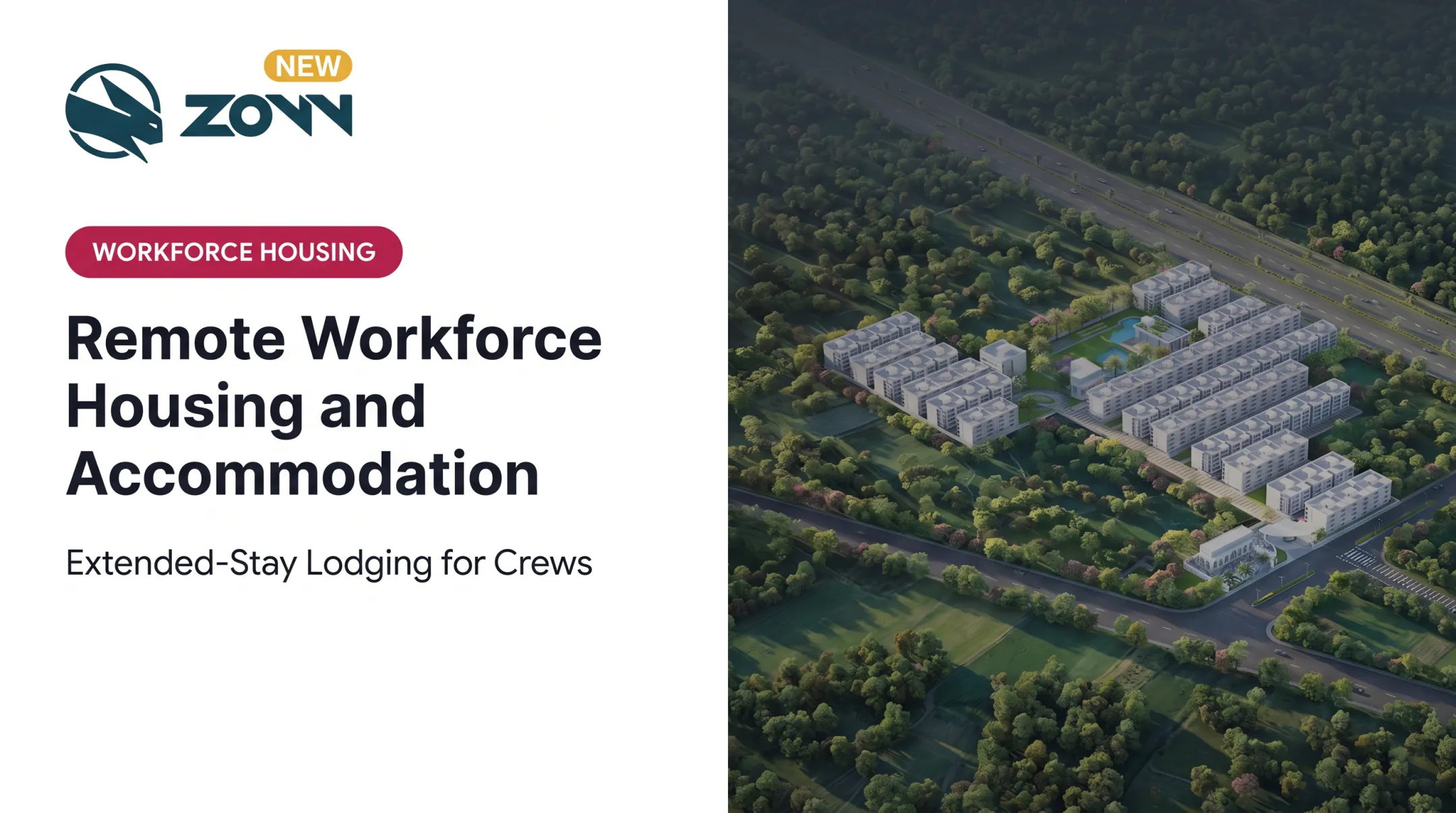

This guide covers employer- and project-arranged accommodation for construction crews, energy and utility workers, telecom teams and contractors. It does not cover permanent low-income housing. You'll find the housing formats available, how to choose, what to budget, and how to manage the program.
Key Takeaways
- Workforce housing here means temporary, employer-arranged lodging, not Section 8 or income-qualified housing.
- Match the format to duration, headcount, shifts, privacy needs, and flexibility to extend or cut bookings.
- Compare total program cost, not just the nightly rate.
- Centralized booking, payment and reporting cut admin work and improve visibility.
What Is Workforce Housing in Pecos?
A practical definition for employers
Workforce housing is temporary lodging arranged for employees, contractors, crews or responders working away from home. Providers and public agencies use the term differently, so confirm which meaning a source intends.
Compared with a leisure stay, these bookings usually involve longer stays, rotating occupants, group blocks, project-based extensions and employer-managed payments.
Who typically needs it?
- Oil and gas support, pipeline and construction crews
- Utilities, renewable energy and telecom rollout teams
- Engineering teams and staffing contractors
- Disaster-response crews
Needs vary by scale. A small traveling team may want a few kitchen-equipped suites. A large rotating crew needs blocks of beds, parking and meals. A multi-city program needs consistent terms and one view of spending.
Workforce housing versus Section 8
Workforce housing depends on the job or assignment. Section 8 and public housing depend on household income. HUD's voucher guidance says eligibility turns on family income, size and citizenship or immigration status.
Employer-paid lodging does not make anyone eligible for public assistance, and it is not a substitute for it. For eligibility questions, go to HUD, the Texas Department of Housing and Community Affairs, or your local housing authority.
What it may include
- Extended-stay hotels and serviced apartments
- Furnished apartments and corporate leases
- Crew lodges and workforce camps
The term describes the use case and management model, not a single building type.
Why Pecos Employers Need Flexible Workforce Housing
Regional project activity
Pecos sits inside a project-driven region. The Permian Basin Workforce Development Area reported 254,395 employed people in August 2025. That is regional data, not a Pecos room-shortage measure.
Project activity is visible too. The Matterhorn Express pipeline runs about 606 miles from near Coyanosa, and a proposed 3,000-acre solar project in Reeves County was announced in October 2025. Neither proves a current lodging shortage, so ask providers directly about availability for your dates.
Schedules change the bed count
Mobilization dates, rotations, phased construction, turnarounds, weather and contract extensions all change the beds and nights you need. Nationally, 42% of surveyed contractors reported projects postponed in 2024 but later rescheduled, according to AGC's 2025 outlook.
Contracts should allow additions, reductions, room changes, extensions and early departures. Cancellation terms vary by property, so read them before signing.
Location and commute
Distance to the job site matters more than distance to town. Published driving figures from Pecos run 74.5 miles to Odessa (about 1 hour 13 minutes) and 96 miles to Midland (about 1 hour 32 minutes). These are city-to-city routes, not times to a well pad or plant gate.
Road risk is real. TxDOT recorded 25,126 Permian Basin crashes and 284 fatalities in 2025. A NIOSH case study describes a fatigue-related rollover that killed two oil and gas workers after a long shift. Verify:

- Current travel time to your actual gate at shift change
- Road access and parking for work vehicles
- Arrival times that suit night or split shifts
Amenities for demanding schedules
CDC/NIOSH guidance says a dark, quiet, cool room improves sleep, with blackout curtains helping daytime sleepers. Prioritize:
- Private or appropriately allocated sleeping areas
- Reliable Wi-Fi and climate control
- Laundry, housekeeping, kitchens or meals
- Secure parking and controlled access
Local data on whether amenities improve productivity or retention is hard to find, so treat them as comfort and safety factors and confirm what each property currently offers.
The historical Pecos Lodge
A January 2013 announcement described Pecos Lodge, a workforce lodge at 23 County Road 116, with capacity for up to 200 workers and a first phase of 90 bedrooms with private bathrooms. Treat those details as historical.
The same address is now listed as Pecos South Lodge, reported at 772 beds at year-end 2025. Capacity is not the same as available beds. Confirm current features and availability before booking.
Housing Options for Pecos Project Teams
Extended-stay hotels and serviced apartments
These suit smaller teams, shorter assignments and workers who want privacy plus housekeeping and front-desk support. Local extended-stay hotels, for example, offer suites with full kitchens.
Trade-offs include rate changes, limited group capacity, hotel-style living, and different policies for extensions or multiple occupants.
Furnished apartments and corporate rentals
Furnished units offer kitchens and living space for longer assignments or workers traveling with family. Check:
- Lease terms, deposits and utilities
- Furnishing standards and cleaning
- Maintenance response times
- Inventory limits in a small, fast-changing market
Confirm furnished-apartment availability before you plan around it; marketed inventory in Pecos can be limited and changes quickly.
Workforce lodges and grouped accommodations
Lodges suit large teams that want centralized rooms, meals, parking, security and recreation near the project. CHS Stonegate at Pecos, for instance, lists furnished workforce homes with private rooms and bathrooms, meals, laundry and housekeeping.
Scale brings shared services, but weigh privacy, transport, property standards, worker preferences and availability for your dates.

How to Source and Manage Workforce Housing in Pecos
Define the requirement first
Before requesting quotes, gather:
- Project address and headcount
- Room or bed configuration
- Arrival and departure dates and rotation schedule
- Shift patterns, vehicles and parking
- Meal and accessibility needs
Separate confirmed demand from forecast demand. Providers quote more accurately, and you keep room to adjust.
Compare the complete cost
Lodging rate is one line. Add:
- Taxes, service fees and deposits
- Utilities, housekeeping, meals and parking
- Transportation
- Cancellation, change and extension charges
Texas charges a 6% state hotel occupancy tax per the Comptroller, and Pecos publishes a 9% town hotel tax. A permanent-resident exemption can apply after 30 consecutive days, but it requires written notice, so ask your provider how it's handled.
For reference, the federal per diem lodging allowance for Reeves County is $125 per night for FY2027, excluding taxes. That is a reimbursement benchmark, not a market quote.
"Cheaper" depends on stay length, occupancy, included services and admin time. Get written quotes from several categories.
Vet the property and provider
Check these items before you book:
- Property condition and occupancy rules
- Security procedures and emergency contacts
- Insurance requirements and accessibility
- Maintenance response times
Ask how the provider handles inspections, complaints, incidents, no-shows, late arrivals and urgent mid-stay changes.
Centralize bookings, payments, and support
One managed process for reservations, invoices, occupant lists, extensions and 24/7 assistance saves coordinators from chasing multiple properties.
WWStay is built for organizations that want furnished apartments, hotels or serviced apartments sourced and managed on one platform. Bookings run through Zovv, WWStay's AI accommodation platform, and the service combines booking, ZovvPay payments, reporting, workforce tracking and traveler support. It uses a 30-point checklist for apartment safety, security and amenities, and manages extensions, room swaps and early checkouts through change management.
Confirm current Pecos inventory and terms before committing.
Plan for changes and shortages
- Identify backup properties and alternate room types
- Line up transportation options and escalation contacts
- Define steps for sudden crew increases, delays or severe weather
After each project, review occupancy, spend, extensions, commute problems, incidents and worker feedback.

Costs, Compliance, and Worker Experience
Cost considerations
Workforce housing may lower total project cost by limiting hotel changes, wasted rooms and admin time. Demand evidence before accepting any savings claim, and treat network-wide figures as directional until you have Pecos-specific data. WWStay reports savings of 10-15% or more across its property network, but results depend on market and program.
Compliance, privacy, and duty of care
Get legal or local guidance on:
- Leases, lodging taxes and occupancy limits
- Accessibility and safety obligations
- Data privacy and employee location tracking
Texas Property Code Section 92.010 caps residential dwellings at three adults per bedroom, but it isn't a universal hotel-room limit. Keep worker tracking transparent, limited to a legitimate safety or operational purpose, and consistent with company policy and law.
Measure beyond price
Track:
- Cost per occupied room or bed
- Utilization and booking lead time
- Extension and cancellation frequency
- Commute burden and incident response
- Worker satisfaction
Pecos-specific benchmarks for these metrics are scarce, so set your own baseline and hold a post-project review with project managers, procurement, travelers and the provider.
Frequently Asked Questions
Is workforce housing the same as Section 8?
No. Workforce housing is typically temporary employer- or project-arranged lodging. Section 8 is an income-qualified assistance program. Check HUD for eligibility.
Is workforce housing cheaper?
It depends on stay length, occupancy, included services, commute and contract terms. Compare total cost, not just the room rate.
How do I qualify for low-income housing in Texas?
Contact TDHCA, your local housing authority or HUD. Eligibility is separate from employer-provided accommodation.
What is workforce housing in Pecos?
It is temporary lodging for employees, contractors or crews working in or around Pecos, such as extended-stay suites, furnished homes, lodges and crew accommodations.
What should employers look for in Pecos workforce housing?
Focus on location relative to the job site, crew capacity, safety, privacy, Wi-Fi, laundry, meals and parking. Also check flexible terms, reporting, emergency support and how well the provider handles schedule changes.